


Graduate Students and Post-Docs (in chronological order)

Gavin Saenz, M.S. student
I joined the Magoulick Lab as a master’s student in Fall 2025. I earned my B.S. in Natural Resources Management with a concentration in Wildlife Biology at Texas Tech University in Lubbock, on the Great Plains of West Texas. During my time at Texas Tech, I worked with the U.S.G.S. Wildlife & Fisheries Cooperative Research Unit under the mentorship of Dr. Jane Rogosch. As an undergraduate researcher, I conducted a project titled “A Gut Content Composition Analysis of Four Native Fishes of the Red River,” which provided baseline knowledge of the spatial and temporal variation in diet habits of species of greatest conservation need. I am now pursuing my M.S. in Biology under the supervision and advising of Dr. Daniel Magoulick. While my thesis project is still being developed, my current focus is on refining my research interests and reviewing relevant literature to form my research question.
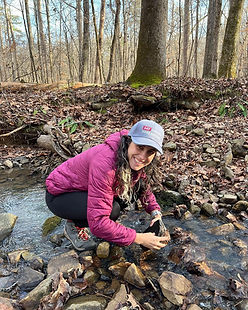
Ana M. Meza-Salazar, Postdoctoral Fellow
I joined the Magoulick Lab as a postdoctoral fellow in spring 2025 to advance research on ecological thresholds in stream ecosystems of the Interior Highlands, USA. My work focuses on applying machine learning approaches, particularly Gradient Forest, to evaluate how hydrologic, climatic, and land use variables influence fish and aquatic macroinvertebrate assemblages. I am especially interested in identifying thresholds along environmental gradients where community composition and trophic guild structure shift abruptly. I earned my PhD in Applied Ecology at North Carolina State University, where my dissertation investigated the impacts of climate change on tropical streams. Much of this work centered on aquatic macroinvertebrates as indicator organisms to assess responses to episodic acidification events and nutrient enrichment from geothermal groundwater inputs. Prior to that, I obtained my Master’s and Bachelor’s degrees in Biological Sciences from Universidad de Caldas (Colombia), where I focused on the effects of land use change on stream macroinvertebrate assemblages and ecosystem functioning. Broadly, my research bridges community ecology, freshwater conservation, and environmental change, using both field-based and data-driven approaches to understand how biodiversity and ecosystem processes respond to hydrologic and climatic variability.

Josh Tivin, Ph.D. student
I received my B.S. in Biology from Miami University of Ohio, where I studied the phenology of gizzard shad in an agricultural reservoir. I completed my M.Sc. in Aquatic Biology at Texas State University in 2023, with a thesis on how extreme flow events shape habitat complexity and fish assemblages in groundwater-dominated systems. After graduating, I worked as a fish taxonomist for Amnis Opes Institute in Bend, Oregon, conducting fish and habitat surveys for the EPA’s National Rivers and Streams Assessment (NRSA) across the western United States. I Joined the Magoulick lab as a PhD student in January 2025. My research interests include freshwater fish conservation, community ecology, and understanding how flow alteration impacts fish communities.

Alexandra King, Ph.D. student
I graduated from Pittsburg State University with a M.S. degree in Biology and a B.S. degree in Ecology and Organismic Biology. During my studies at Pittsburg State University, I examined the long-term response of riffle fish communities to pollution remediation efforts and investigated the extent of invasion and frequency of hybridization of a nonnative fish species in the Spring River sub-basin. I joined the Magoulick lab in the fall of 2024. My research focus here at the University of Arkansas is to examine the response of spawning engineers and their nest associates to environmental and hydrological stressors in the Interior Highlands of Arkansas. This research will improve our knowledge of spawning microhabitat specialists and how the response of ecosystem engineers to anthropogenic land use and climate change influences habitats and aquatic species assemblages. My long-term goal is to get a PhD and teach to help students pursue career goals of their own and contribute to conservation and environmental health efforts. I seek to solve problems and find solutions to help build a better future for mankind and the diversity of species we share the planet with.

Kearstin Findley, Ph.D. student
I received my B.S. in Ecology and Evolution at Rockford University in my hometown of Rockford, Illinois in 2018. Subsequently, I earned my M.S. working with Dr. Kyle Piller at Southeastern Louisiana University in Hammond, LA in 2020. My master’s thesis focused on using ecological niche modeling and targeted field sampling to evaluate the distribution of six imperiled freshwater fish species in Louisiana. Currently, I am pursuing my PhD in Biological Sciences at the University of Arkansas. My dissertation research focuses on evaluating current and future climate impacts on Yellowcheek Darter (Nothonotus moorei) survival, growth, and refuge use. My research interests include freshwater fish conservation, ecological niche modeling, conservation of imperiled species, and fish ecology.
Recent Past Lab Members

Chloe Moore Voorhees, Postdoctoral Fellow - Postdoc at Woods Hole
I joined the Magoulick Lab as a postdoc in fall 2023 to continue the ongoing research on flow-ecology relationships for fish and aquatic insects in the Interior Highlands region, USA. More specifically, I am investigating relationships between flow regime and assemblage trait composition to identify thresholds along hydrologic alteration gradients wherein the functional composition is predicted to fundamentally change. I obtained my PhD from Virginia Tech researching spatial and temporal patterns and drivers of multidimensional biodiversity for anurans (frogs and toads). Prior to that, I received my BS from the University of Georgia and researched hellbender distributions using environmental DNA. Generally, my research revolves around identifying connections between species characteristics, the environment, and patterns of diversity, using tools from population genetics, community ecology, and spatial ecology.

Leah Bayer, Ph.D. student - Postdoc at West Virginia University
I received my BS in Biology and Mathematics from Youngstown State University. I am currently pursuing a PhD at the University of Arkansas. My research interests include ecological modeling, population ecology, and conservation of imperiled species.

Sarah Sorensen, Ph.D. student - Postdoc at University of Wyoming
I received my B.S. from Purdue University and Masters of Environmental Science from University of California - Santa Barbara. While in California, I worked in the Los Padres National Forest and the Angeles National Forest, surveying sedimentation in waterways and establishing baseline habitat surveys for California steelhead trout. I am currently pursuing a PhD at the University of Arkansas. My research interests include looking at how stressors impact population and community dynamics.

J. Tyler Fox, Post-Doctoral Fellow - The Nature Conservancy River Conservation Programs
Tyler joined the Magoulick Lab in fall 2017 to research flow-ecology relationships for streams in the Ozark-Ouachita Interior Highlands and West Gulf Coastal Plains. The results of this work will form the basis for setting regional environmental flow standards and understanding impacts of land use and climate change. Tyler received his Ph.D. in Fish and Wildlife Conservation in 2015 from Virginia Tech, researching spatiotemporal patterns and drivers of surface water quality and landscape change in southern Africa. He completed his M.S. at the University of Central Arkansas studying water quality in cave streams and resurgence springs in southeastern Missouri’s karst/sinkhole plains. His specific research interests include: quantitative landscape ecology for conservation and management of natural resources and wildlife, focused on complex coupled human-natural systems, and individual, population, and community responses to global change; human and environmental drivers of water quality and health; and geospatial analysis and modeling of multivariate time series.

Robert Fournier, Ph.D. student - Postdoc at University of California, Berkeley
I received a BS from Florida State University and a MS from Louisiana Tech University. I am currently pursuing a PhD in Biology at the University of Arkansas. My research interests are community ecology, predator-prey ecology, and stream ecology. My teaching interests are General Biology and Ecology.

Chris Middaugh, Ph.D. - working as Research Biologist for Arkansas Game and Fish Commission
I received my BS in biology from Lyon College and my MS in fisheries science from Purdue University. I worked as a fisheries biologist for Florida Fish and Wildlife for two years. At the University of Arkansas I examined how climate change and land use affect smallmouth bass population dynamics.


Nicky Graham, M.S. - working as Research Biologist for Idaho Dept of Fish and Game
I received a BS in Environmental Studies from Virginia Commonwealth University. At U of A, I examined effects of drought disturbance and invader source population on native crayfish population dynamics.
Allyson Yarra, M.S. - working for MA Department of Environmental Protection
I received my BS in Fisheries Ecology and Conservation at the University of Massachusetts where I studied the effects of anthropogenic alterations to flow regimes and impacts on aquatic biota. For my MS I focused on the influence of disturbance (drought, predation, invasive species) on crayfish in the Ozark Highlands with an emphasis on species of greatest conservation need.
Lindsey Bruckerhoff, M.S. - Assistant Professor at Ohio State University
I am primarily interested in stream ecology, especially factors driving population and community dynamics. While pursuing my BS in Wildlife Biology at Missouri State University, I looked into dispersal mechanisms for aquatic invasive species in northern Wisconsin. At U of A my research focused on the relationship between stream hydrology and fish assemblages. Specifically, I examined at how variation in hydrologic factors in Ozark streams influence recruitment success in fish.